Osmo Hardwax Oil Natural 3041 VS Farbig 3040 White
Do you want to maintain a light appearance on wood, but are unsure between different white finishes? In this article, we explain the difference between Osmo Hardwax Oil Natural 3041 and Osmo Hardwax Oil Farbig 3040 White, so you know exactly what effect to expect on the wood.

Products in this knowledge item;
Light colors for wood
Osmo Hardwax Oil Natural 3041 and Farbig White 3040 offer wooden floors and furniture a light-colored, wear-resistant, and dirt-repellent finish.
What exactly is the difference between these two products, and how much white pigment do both contain?
For a wooden surface, the white pigment in Natural 3041 is not designed to be visible due to its low percentage. The 3041 contains approximately 5% white pigment, giving a nearly untreated effect to light wood types such as oak, beech, and pine. More white pigment has been added to Hardwax Oil Farbig 3040, approximately 10%. This ensures that the wood turns a transparent white; with this variant, you will therefore see a white tint on the wood.
Hardwax Oil Natural 3041
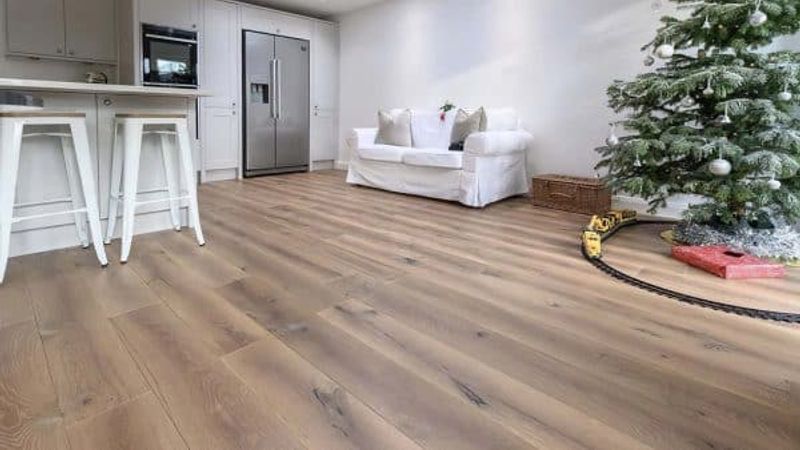
Thanks to the low percentage of white pigment in Natural 3041, this product was developed to create an almost untreated effect. Light wood types remain light in color with this.
Colorless products containing no white pigment
Treating the wood with colorless Hardwax Oil colors it as if it has been wet; we call this a wet look effect. This deepens the color of the wood. With light wood types such as oak, this can turn slightly yellowish. Hardwax Oil 3041 Natural was developed to preserve the light color of the sanded wood.
For the best result, Hardwax Oil Natural 3041 should be applied thinly and rolled or brushed out well. This prevents brush marks. Ensure that all parts of the wooden floor are covered; otherwise, color differences will occur.
Any pigment remaining on the surface must be removed before the surface can dry. The second and final layer should be applied with colorless Hardwax Oil Original. These two products together create an untreated effect. When the second layer is also treated with Natural 3041, a whiter/lighter surface is created.
Hardwax Oil Farbig White 3040
Osmo Farbig White 3040 contains more white pigment, resulting in a finish that is whiter than Natural 3041, which creates an almost untreated effect. The 3040 White creates a transparent white appearance on the wood, while the wood structure and grain remain visible.
If you choose White 3040, it is possible to apply a second coat using the white variant as well. This creates a whiter effect. You can also choose to apply one coat of 3040 and one coat of Hardwax Oil Original colourless.
Unlike other variants of Hardwax Oil Farbig, Hardwax Oil Farbig 3040 can be used as both the first and second coat to prevent possible yellowing. Applying a colourless Hardwax Oil as a second coat can make white finishes appear slightly yellowed.
For an even whiter effect, the wood can be treated with Osmo Oil Stain 3501 White. This product can provide both a white wash and an opaque white effect. Applying one coat creates a white wash on the wood. Applying two coats creates an opaque effect. It is always recommended to finish the wood with the colorless Hardwax Oil Original for the best protection.
The color examples below were created on oak. Every type of wood and every surface is different; therefore, the color and appearance may differ from the image below. For this reason, always perform a test first using the Osmo test packs to avoid any surprises.
Hardwax Oil Effect color samples
Hardwax Oil Farbig color samples
Oil Stain color samples
Apply Hardwax Oil 3041 Natural or 3040 White
1. Stir the product well for 2 minutes. After opening the can, the Oil and Wax have separated. Always perform a test on the surface first to check if the result has the desired effect.
2. Apply the first layer of Hardwax-Oil Effect very thinly with a roller or floor brush to the new or sanded wood. Ensure that the product is rolled out well; otherwise, the surface will suffer from application streaks. Ensure that all parts of the wood are covered with the product. A brush is recommended for edges and hard-to-reach areas.
3. Mistakes made during application can be corrected on the wet surface up to 30 minutes after application. This includes application streaks from a roller or bristles from a brush.
4. The drying time for the first layer is approximately 24 hours (at 23 degrees and 50% relative humidity). Drying takes longer at lower temperatures or higher humidity. Good ventilation must be ensured at all times. Therefore, ensure that windows and doors are open.
5. Apply the second finishing coat thinly with Hardwax-Olie Original Colorless. Also apply this layer with the Osmo Microfiber Roller or Floor Brush.
6. Drying of the second coat in approx. 8-12 hours; see point 4.
Products
Prevent line breaks and pigment accumulation
Applying too much product or failing to remove excess oil and pigment from the wood surface will result in a chalky or milky finish after drying. Failure to properly roll out and re-roll the Hardwax Oil can cause application streaks on the wood. Therefore, always re-roll the treatment thoroughly without product on your microfiber roller.
Before applying the Hardwax Oil with white pigment, it is necessary that the wooden surface is sanded; this is not necessary for new wood. Old paints and varnishes must be completely removed. Sand wooden surfaces carefully and gradually. Start with coarse sandpaper, grit 40, then 80, and finish with grit 120.
Before applying Hardwax Oil, all sanding dust must be removed; this can be done by vacuuming. Do not mop the wood, as this can cause water to penetrate the untreated wood. The wood also does not need to be degreased; sanding alone is sufficient.
Hardwax Oil Natural 3041

Hardwax oil Farbig 3040 White
Hardwax Oil Original Colorless
Sanding advice
Sanding finer than grit 120/150 can cause the wood grain to become more closed, making it more difficult for the Hardwax Oil to penetrate the wood. Having very smooth textures will also ensure that the wood absorbs less white pigment. Sanding too finely can therefore result in a poor outcome where the oil, wax, and white pigment remain on the surface of the wood and cannot penetrate it. Therefore, always sand the wood to a maximum of grit 120/150. This allows the Osmo Hardwax Oil to bond well with the wood, resulting in a beautiful outcome.
Resolving imperfections
If you notice that a milky finish has formed after applying the first coat with white pigment, or if there are application streaks or accumulations of white pigment in the dried layer, it is advisable to lightly sand the first coat. The goal here is only to sand off the excess dried finish, not the wood itself. This is best done using grit 120/150/180. Ensure that you sand along the grain of the boards; this prevents visible scratches caused by the sandpaper. Sanding can be performed either by hand or with a sanding machine.
Once sanded and dust-free, apply a new layer of the Hardwax Oil with white pigment. It is recommended to wipe away excess product with a lint-free cloth after 20 minutes. Dry polishing should always be performed along the grain of the board and wood. For this, you can use the Osmo Easy Pad Polishing Cloths or the Osmo Fleece pad. After this polished layer has completely dried, the wood can be finished with Hardwax Oil Original colorless for a well-protected surface. The layer of colorless Hardwax Oil can be applied with a microfiber roller. Ensure that you roll out the Hardwax Oil well and apply it thinly.
Need help with your DIY project?
Are you looking for a tutorial or do you have a technical question?
DIY help needed?
find a step-by-step guide for your project in our tutorial overview