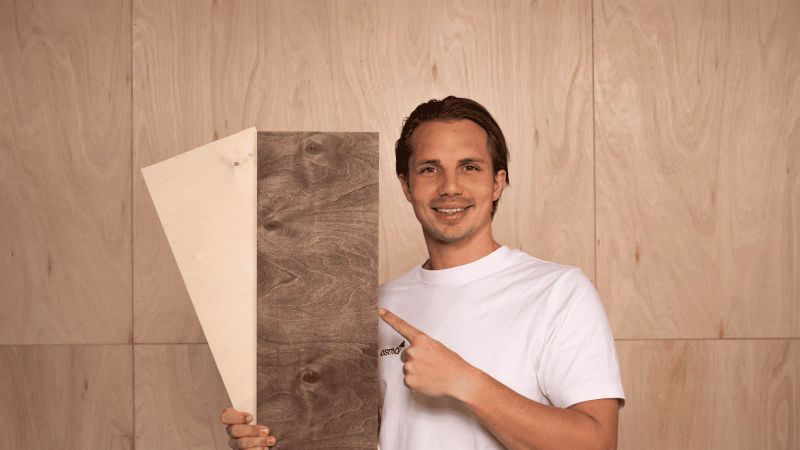
Treating thermally modified wood
As an alternative to tropical hardwood, more and more so-called technically modified wood species are entering the market. This modification alters not only the natural wood properties but also the properties of the treatments.
Products in this knowledge item;
Below, we discuss the most important technically modified wood types and explain the possibilities for treating them with Osmo. Treating the modified wood extends its lifespan and reduces the rate at which it greys, algae, and fungi develop.
What is modified wood?
This is wood that has undergone a special heat treatment that extends its lifespan. Softwoods, in particular, are modified to become almost hardwood. The wood is heated to approximately 200 degrees, without the use of chemicals. Modifying wood changes its chemical structure, resulting in reduced moisture content. In addition to extending its lifespan, it is also better protected against fungi and wood rot.
Wood species highly suitable for thermal modification include: spruce, ash, pine, and ayous.
Products for treating thermally modified wood
Treating thermally modified wood
Untreated thermally modified wood greys very quickly. Therefore, we recommend treating the wood within the first two weeks after installation. All Osmo exterior finishes can be used on thermally modified wood. Due to the good oil absorption properties, more oil may be required than indicated.
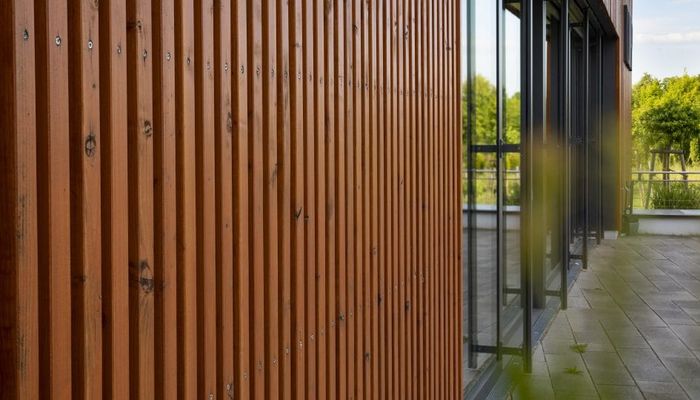
For vertical wood such as a fence or facade, you can apply Osmo UV Protection Oil. This protective oil with a UV Factor of 12 ensures that the wood is protected against UV radiation 12 times better than without treatment. The product is available in a colorless variant as well as in natural color shades.
For horizontal wood, Osmo Terrace Oil or Natural Oil Stain can be applied. These oils are available in many different transparent colors. The treatment ensures that the wood receives protection against UV radiation, fungi, and wood rot. In addition to horizontal wood, these two products are also suitable for vertical wood such as fences, posts, and pergolas.
For a covering effect, Osmo Country House Paint can be applied. This opaque oil-based exterior paint protects against UV radiation, moisture, and mold, just like the other exterior products.
UV Protection Oil color samples
Natural Oil Stain color samples
Country house paint color samples
Pressure-impregnated pine
For pressure-impregnated wood, the pine wood is placed in a large boiler, where 9.5 bar is applied. After closing the door, the boiler is vacuumed, removing the air from the wood. Once the boiler is almost depressurized, it is filled with the impregnating agent. The impregnating agent is forced into the wood, causing the pressure inside the boiler to drop. When the pressure drops to a certain value, the pump restarts to raise the pressure back to 9.5 bar. This process continues to repeat until the pressure no longer drops. After this process, the wood is preserved to the maximum extent.
Due to the impregnating salts, the absorption of the treatment is limited immediately after application. Through weathering over approximately six months, excess salt is washed away, allowing the wood to absorb the protective finish. After weathering, we recommend de-graying the wood with Osmo Power-Gel Wood De-grayer and then applying the treatment. The Power-Gel removes graying and brings out the natural color of the wood. All Osmo exterior finishes can be used on pressure-impregnated pine.
Treating Accoya® wood
Due to the acetylation of Accoya wood, it is generally more durable, stable, and lasts longer. When using light-colored treatments, an additional impregnation layer is necessary because acetylated wood (usually acetylated Pinus Radiata) is more susceptible to mold. This impregnation layer can be created by applying a layer of Osmo WR Wood Impregnation. Afterward, acetylated wood can be treated without problems with any Osmo exterior finish.
Treating Kebony® Timber
Through impregnation with Furfuryl alcohol, the wood cells are cross-linked and moisture absorption is significantly reduced. However, an additional impregnation layer is still recommended, as the impregnated wood is susceptible to mold. Therefore, it is advisable to first treat the wood with Osmo WR Wood Impregnation 4001. Kebony® wood can be treated with any Osmo finish immediately after processing.
Durable Wood
Due to impregnation with paraffin wax, there is a risk that the wax will be released again when the wood is exposed to extreme weather conditions (heat). Even during priming, the wax makes it difficult to achieve good penetration and optimal adhesion between our finishes and the wood. Therefore, we advise against treating durable wood with an Osmo exterior finish.
Wood species rich in extractants
Please note that surface weathering significantly increases the absorption of the finish by the wood. Therefore, it is also recommended for technically unmodified wood, particularly wood species rich in extractants (including European oak), to wait for the right moment to treat the wood. Therefore, always allow these wood species to weather outdoors for at least 6 weeks first, so that the wood can acclimate to outdoor conditions. The wood will turn grey during weathering. The greying can be removed with Osmo Power-Gel; this Gel brings out the natural color of the wood. Afterwards, it can be treated with an Osmo Exterior Finish of your choice.
Need help with your DIY project?
Are you looking for a tutorial or do you have a technical question?
DIY help needed?
find a step-by-step guide for your project in our tutorial overview