Cleaning and treating your Douglas fir wooden facade yourself? Follow this step-by-step plan!
In this tutorial, we explain how to remove old layers of paint, or in this case an old linseed oil treatment, from a Douglas fir facade. Osmo Verf Remover Gel can remove old layers of paint, stain or oil, so that the wood can absorb a new treatment again. To protect this facade for a longer period this time, we use Osmo UV-Beschermingsolie. It is water-repellent and provides long-lasting protection against UV radiation up to factor 12!

What you need for this tutorial;
Douglas fir cladding: beautiful, but vulnerable to UV radiation
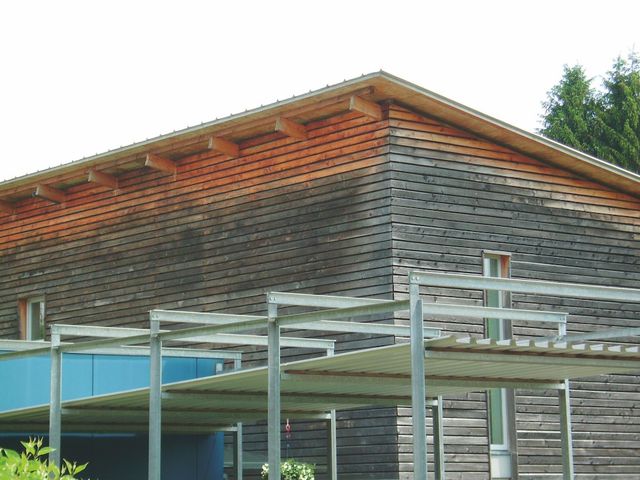
Douglas fir cladding is a popular choice for facades thanks to its natural look, durability and attractive purchase price. Most professionals treat Douglas fir with a colorless oil such as linseed oil. Unfortunately, UV radiation quickly breaks down this protection, causing the wood to absorb dirt and eventually turn gray.
That graying is not just unsightly: poorly protected Douglas fir dries out, starts to move and can crack over time. As a result, moisture penetrates deeper into the wood, which considerably shortens the lifespan of the cladding. By using the right products, you extend the maintenance interval and Douglas fir cladding can last for decades.

Grayed Douglas fir facade, treated with linseed oil
Removing old paint layers or linseed oil: how do you go about it?
Many wooden facades have been treated with paint, stain or linseed oil in the past. Before you can apply a new protective layer, those old layers must be removed completely. A new coat of oil or stain does not adhere well to a surface that is already saturated with an older product.
Option 1: Sanding or burning
Sanding or burning and scraping are well-known methods for removing old layers of paint or stain, but they have an important drawback: sanding an entire facade is a labor-intensive and time-consuming job.
Option 2: Osmo Verf Remover Gel (recommended)
A more effective and sustainable alternative is Osmo Verf Remover Gel. This gel has been specially developed to remove old layers of paint, stain and oil from wood, including stubborn linseed oil. You apply the gel thickly to the surface, the gel soaks into the old layer and loosens it without damaging the wood. This way you remove old paint layers without sanding.
This makes the Verf Remover Gel the most efficient method for cleaning a wooden facade with older treatments.

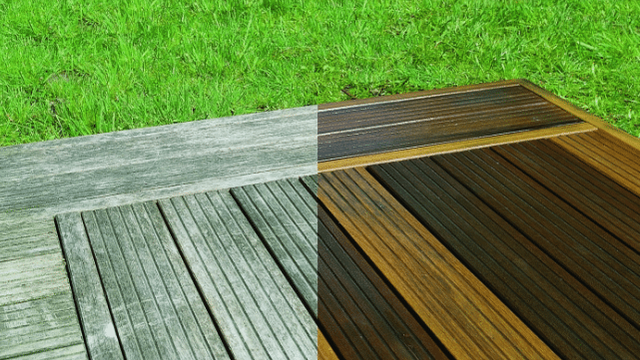
Before and after of the wooden facade
These are the photos of the facade before and after cleaning and treatment.

The facade BEFORE cleaning and treatment
The grayed Douglas fir facade

The facade AFTER cleaning and treatment
After cleaning and treating the Douglas fir facade
Supplies for cleaning and treating your facade
Videos about cleaning and protecting a wooden facade

Houten gevel reinigen zonder schuren: zo pak je lijnzaadolie aan

Zo bescherm je een Douglas houten gevel tegen UV (deel 2/2)
Cleaning and treating a wooden facade
Follow this step-by-step plan for cleaning and treating wooden cladding.
Cleaning off green deposits and old treatments
Start by removing coarse dirt with a hand brush or soft broom. Then make sure you remove green deposits, so that the Verf Remover Gel can soak properly into the old layer of paint or oil.
Apply the Verf Remover Gel generously to the surface with a (block) brush
Make sure the facade is dry and free of loose dirt. Apply the Verf Remover Gel generously to the wood with a brush or roller. Then let the gel work for 60 minutes according to the instructions on the packaging.

Brush the Verf Remover Gel off the surface
After 60 minutes, scrub the gel off the wood with a stiff brush and plenty of water. You will see the old treatment come loose. Make sure the gel is really completely removed.
After brushing and rinsing, let the surface dry for 24 hours.

Zelf toevoegen:
Garden hose
Neutralize the surface with Osmo Power-Gel
Before you can apply a new treatment to the wooden facade, you must make sure the Verf Remover Gel has been neutralized. If you do not do this, a new treatment may not adhere. In addition, the Power-Gel draws stains and graying out of the wood, so you start on a clean surface.
Use Osmo Power-Gel for this. Just like the Verf Remover Gel, apply it generously with a block brush. Wait 20 minutes before you brush it off.

Brush off the Power-Gel with plenty of water
Make sure you remove the Power-Gel thoroughly with the garden hose and a stiff brush.

Rinse the Power-Gel off thoroughly
Then let the surface dry thoroughly for a day
Zelf toevoegen:
Garden hose
Apply the UV-Beschermingsolie after drying
When the wood is thoroughly dry after at least 48 hours (this depends on the weather in the previous days), you can apply the UV-Beschermingsolie. After 2 coats, the wood is fully saturated, the surface is water-repellent and it is protected against UV radiation up to UV factor 12.
After applying the first coat, you must wait 12 hours before you can apply the second coat. You cannot work wet-on-wet with Osmo.

Apply the 2nd coat after drying
You can roll and/or brush a maximum of 2 coats before the wood is saturated. After that, it no longer absorbs and the wood will dry less well.
With the 2nd coat, you will notice that the wood absorbs less than the first time. So make sure you distribute the oil well and apply a thin coat. The oil then dries to a silky matte finish within 12 hours!

Maintenance: how to keep your wooden facade looking good for years
After the treatment, you will need to maintain the protection periodically, because everything outdoors weathers. The interval depends on the orientation of the facade (sun, rain, wind) and the age of the wood. Douglas fir is more vulnerable than hardwood species or thermally modified wooden cladding.
So check your facade every year for dull areas. Compared to other brands, maintaining Osmo treatments is very simple.
For regular maintenance:
- Clean the surface with Osmo Terrasreiniger to remove green deposits.
- Has the wood turned gray? Remove the graying from the wood with Osmo Power-Gel. If you do not do this, a new coat of oil cannot soak in.
- Rinse thoroughly with water and let the wood dry.
- Then apply a new coat of Osmo UV-Beschermingsolie.
So you do not need to sand or degrease.
Frequently asked questions
Douglas fir cladding
Removing old layers
Protecting wooden cladding
Maintenance
This tutorial belongs to
What you need for this tutorial;
We're happy to help
Looking for DIY advice or have a technical question?