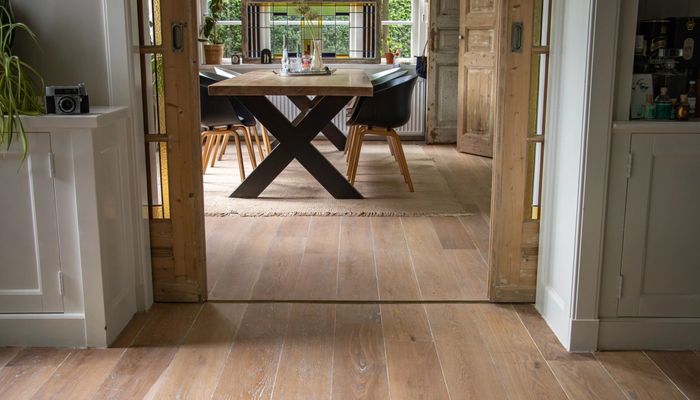
For bamboo indoors, use Osmo Hardwax-Olie Original on floors and Osmo TopOil on worktops and furniture. An oil penetrates the material and lets it move with the humidity, whereas a hard lacquer layer can crack over time.
Which oil for which bamboo surface
Treat a bamboo floor with two thin coats of Hardwax-Olie Original. The first coat penetrates, the second hardens in the upper pores and makes the surface hard-wearing and water-repellent. For a bamboo worktop, table or bathroom vanity, choose TopOil, which is resistant to coffee, wine and water and safe for contact with food.
Bamboo is hard but it moves
Bamboo is not wood but a type of grass, pressed into planks or panels. It is hard and dense, so an oil penetrates more slowly than with many wood species. That is why you apply thin coats and wipe off excess oil after a few minutes. This prevents patches that stay sticky. Because bamboo reacts to moisture, a well-ventilated room with stable humidity is important.
Natural or carbonised
Natural bamboo is light in colour, while carbonised bamboo has been heated to a caramel brown. On the dark variety, preferably choose 3032 satin matt or 3065 semi-matt, as a fully matt oil can leave a white bloom on dark surfaces. Always test a colour or sheen on an offcut first.
Maintaining oiled bamboo
Mop an oiled bamboo floor with Wisch-Fix; the small amount of wax nourishes the finish. Refresh walkways with the Vloeibare Onderhoudswas. You will find more tips in Wooden floor maintenance.