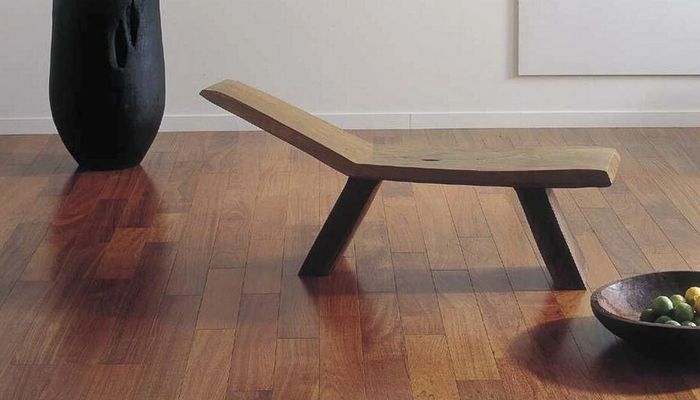
For jatoba indoors, use Osmo Hardwax-Olie Original on floors and Osmo TopOil on tables and worktops. Jatoba is a very hard tropical wood species, and an oil finish adds protection against moisture, dirt and wear to that hardness.
Which oil for which jatoba surface
Treat a jatoba floor or staircase with two thin coats of Hardwax-Olie Original. For a tabletop or worktop, choose TopOil, food safe and resistant to coffee, wine and water. On tropical wood, apply TopOil by buffing it on in thin coats with a pad or lint-free cloth. If the floor does not absorb the Hardwax-Olie well, use Blanke Was. It contains less wax and is made specially for tropical hardwoods that are naturally somewhat oily.
Jatoba darkens
When laid, jatoba is often pink to orange-brown, and under the influence of light it changes to a deep reddish brown in the first months. This is normal and also happens under an oil. So do not put rugs down too soon, or lighter patches will appear. A transparent oil lets this natural colour change happen evenly.
Choose the right sheen level
On dark and tropical wood species, a fully matt oil can leave a white bloom. For Hardwax-Olie Original, choose the 3065 semi-matt or 3032 satin matt, not the 3062 matt. For TopOil, 3028 satin matt is the safe choice. Because jatoba is so dense, apply thin coats and wipe off any excess oil after a few minutes. Always test on a piece of offcut first.
Caring for oiled jatoba
Mop a jatoba floor with Wisch-Fix and refresh walkways with the Vloeibare Onderhoudswas. Keep tables and worktops clean with the Spray-Cleaner.